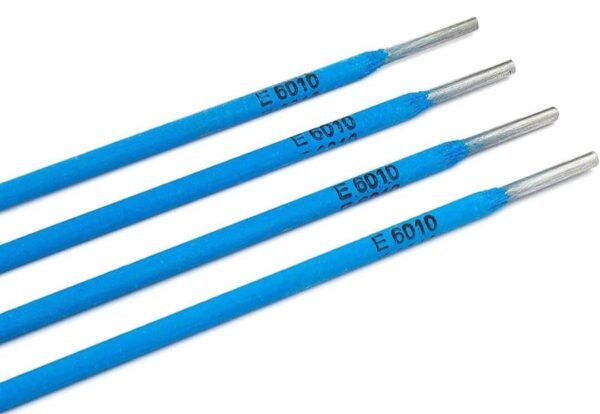
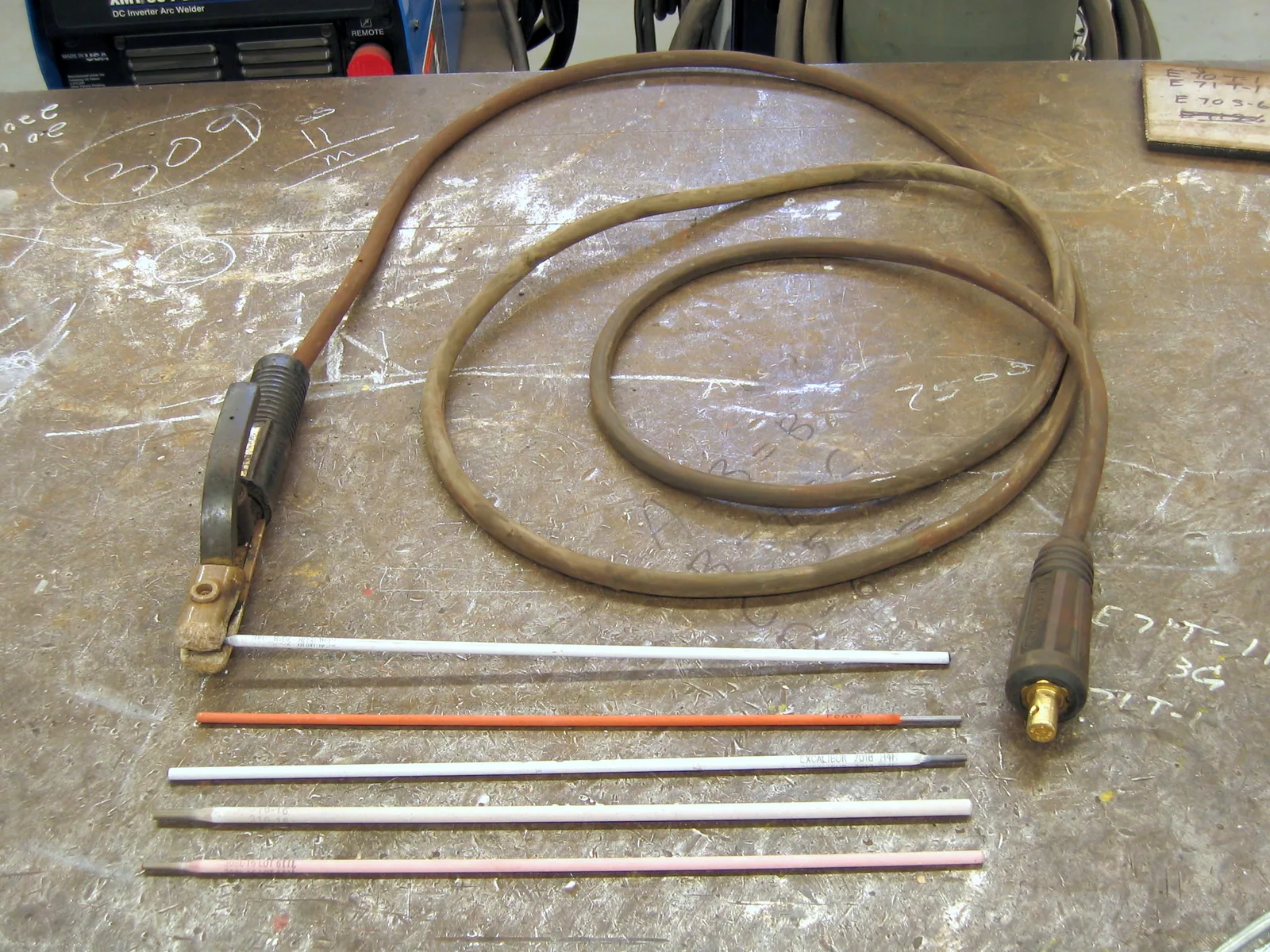
A covered welding electrode is a consumable rod that carries current to the arc and, in most applications, supplies filler metal to the joint. Its coating is not merely protective packaging. The flux system influences arc stability, pool shape, shielding gas, slag, penetration and even final weld-metal composition. Selection therefore begins with the base metal, joint design, welding position, service requirements and approved WPS—not with habit or a trade name.
What is a covered electrode made from?
The core wire conducts current and supplies most of the deposited metal. Its diameter affects current range, deposition rate and pool size. The flux coating may include minerals, gas-forming compounds, deoxidizers, alloy additions and binders. As it melts, it shields the arc and molten metal from the atmosphere and leaves a slag layer over the solidifying bead.
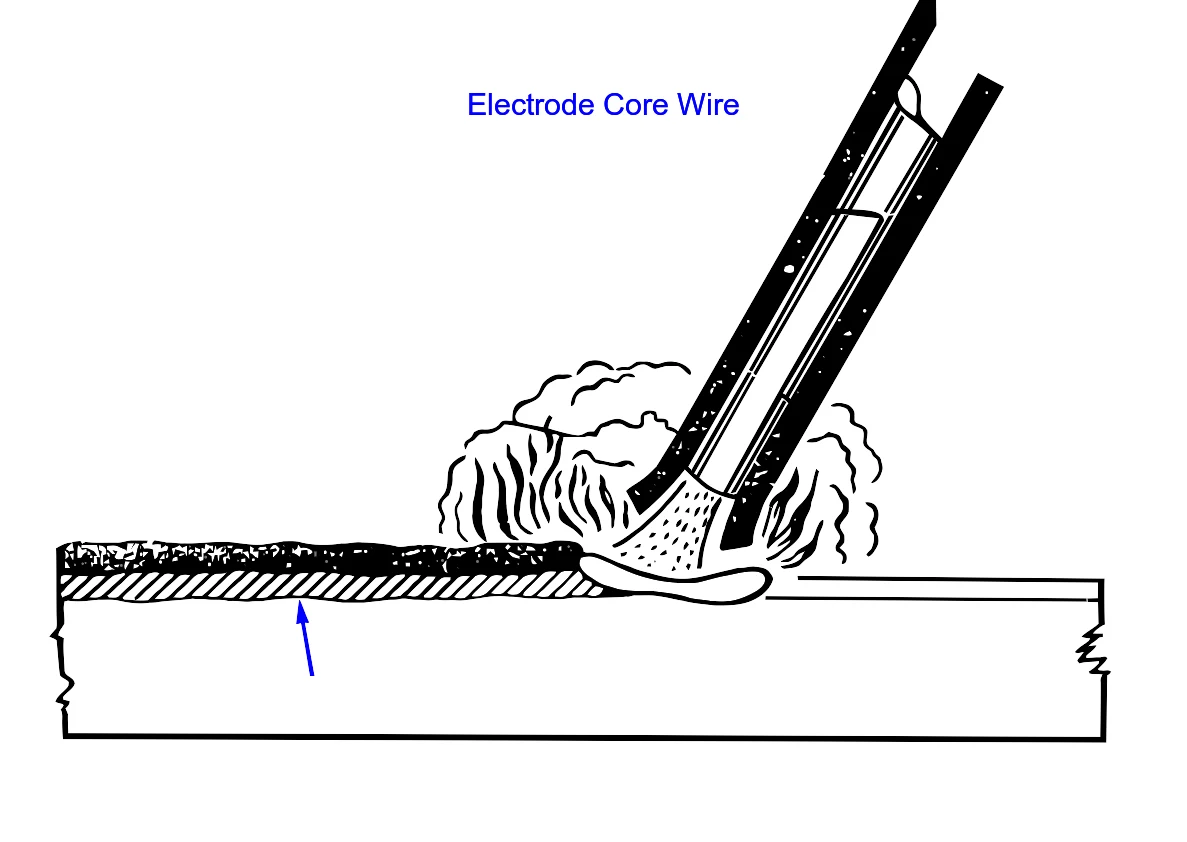
What does the coating do in a few seconds?
When the arc starts, part of the coating forms shielding gases, deoxidizing ingredients react with oxygen, and other constituents create liquid slag. That slag moves over the molten metal, influences bead shape and cooling, then separates after solidification. Cracked coating, damp packaging and incorrect polarity are therefore more than cosmetic problems: each can disrupt a system engineered to protect and control the weld pool.
Main families of welding electrodes
Rutile electrodes: smooth arc for general fabrication
Electrodes such as E6013 are commonly associated with easy striking, a relatively smooth arc and a tidy bead in general fabrication. Ease of use does not replace verification of mechanical and service requirements.
Cellulosic electrodes: penetration and root-pass control
The cellulosic family, including E6010, provides a concentrated arc, deep penetration and fast-freezing slag. It appears in qualified procedures for pipe and root-pass work. Welder technique, arc length and keyhole control are critical.
Basic or low-hydrogen electrodes
E7018 is a familiar low-hydrogen classification for structures, vessels, machinery and restrained joints. Its hydrogen-control benefit depends on correct packaging, storage and exposure control. See the E7018 storage guide.
Stainless steel electrodes
“Stainless” is not one selection. E308L-16 is commonly considered for 304/304L, E309L-16 for many dissimilar stainless-to-carbon-steel joints, and E316L-16 for 316/316L. Process media, temperature, dilution and heat-input limits still need review.
Low-alloy electrodes
With E7018-A1, E8018-C3 or E9018, alloy content, low-temperature toughness, elevated-temperature service and PWHT condition matter beyond nominal tensile strength. The low-alloy electrode guide compares these families.
How is an electrode classification read?
In a common classification such as E7018, E identifies an electrode. The leading digits relate to nominal minimum weld-metal tensile-strength class; the next digit indicates permitted welding positions, and the final digits relate to coating family and allowed current/polarity. Suffixes such as A1, C3, -1 or L may define chemistry or supplementary requirements.
| Code portion | General meaning | What to verify |
|---|---|---|
| E | Welding electrode | Intended process and governing standard |
| 60 / 70 / 80 / 90 | Nominal tensile-strength class | Base metal, design and heat-treatment condition |
| Position digit | Permitted position range | Flat, horizontal, vertical or overhead under the WPS |
| Final digits | Coating family and permitted current | AC, DCEN or DCEP from the datasheet |
This is an orientation guide. Final interpretation must use the current standard edition, manufacturer datasheet and batch certificate.
Practical electrode-selection checklist
- Identify the base metal: exact grade, thickness and heat-treatment condition matter.
- Define service: temperature, corrosion, impact, pressure and fatigue can change the selection.
- Review joint and position: root opening, groove, access and vertical/overhead work affect family and diameter.
- Match the power source: AC/DC capability, polarity, current range and duty cycle must be suitable.
- Confirm quality requirements: strength, impact, chemistry, diffusible hydrogen and PWHT condition belong in procurement documents.
- Plan storage and traceability: moisture, coating damage and mixed batches can defeat a technically correct selection.
Use the welding-electrode supply and quotation page to compare available classifications and prepare an enquiry.
Which detailed guide should come next?
This article provides the selection map. Detailed operating subjects remain in focused guides so that their search intent and technical scope do not overlap:
- For diameter, starting current and low/high-amperage symptoms: electrode diameter and amperage.
- For cellulosic versus low-hydrogen behaviour: E6010, E7016 and E7018 compared.
- For moisture control after opening a package: E7018 storage and redrying.
- For common stainless classifications: 308L, 309L and 316L compared.
Common selection and handling mistakes
- Selecting only from tensile-strength digits while ignoring toughness, chemistry and PWHT.
- Interchanging E6010 and E7018 without changing the WPS, technique, polarity and handling plan.
- Redrying every electrode at one temperature; some coatings can be damaged by the wrong cycle.
- Mixing batches, diameters or classifications in heated storage without traceability.
- Increasing amperage to compensate for contamination, poor leads or incorrect technique.
Frequently asked questions
Which electrode should I buy for ordinary welding?
“Ordinary” is not a technical specification. Identify metal, thickness, position, joint duty and power source. For structural work, drawings and the WPS govern selection.
Is E7018 always better than E6013?
No. They are designed for different arc behaviour, properties and handling conditions. E7018 is low hydrogen and needs stricter storage; E6013 is often associated with general fabrication and a smoother arc. The joint requirements decide.
Are the numbers an electrode brand?
No. E6010 and E7018 are technical classifications. Products sharing a classification can still differ in operating range, packaging and certified properties, so compare the datasheet and certificate.
Conclusion
A welding electrode is an engineered consumable, not simply a metal rod. Core wire, coating, strength class, permitted position, polarity, service conditions and storage all influence performance. A reliable workflow identifies the metal and service, reviews the WPS, selects the full classification, checks the datasheet and then verifies batch and operating parameters.
Image credits: electrode and holder photograph from Wikimedia Commons / Triddle; SMAW diagram from U.S. Army / Wikimedia Commons. Both are public-domain works. Site copies were resized and compressed for web delivery.