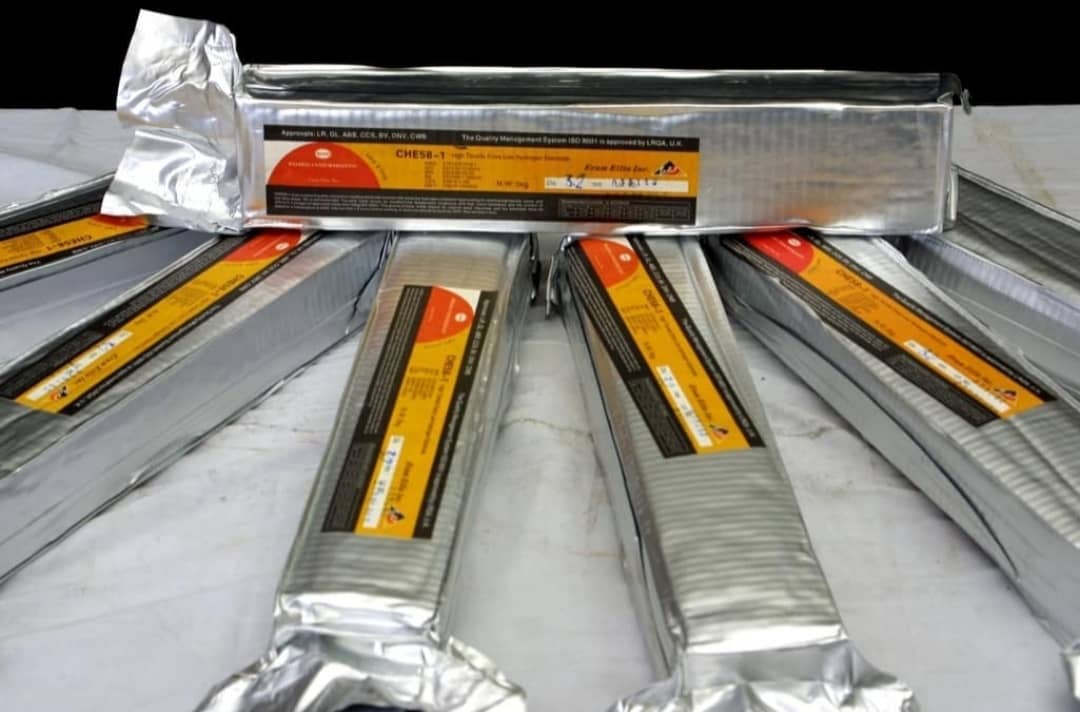
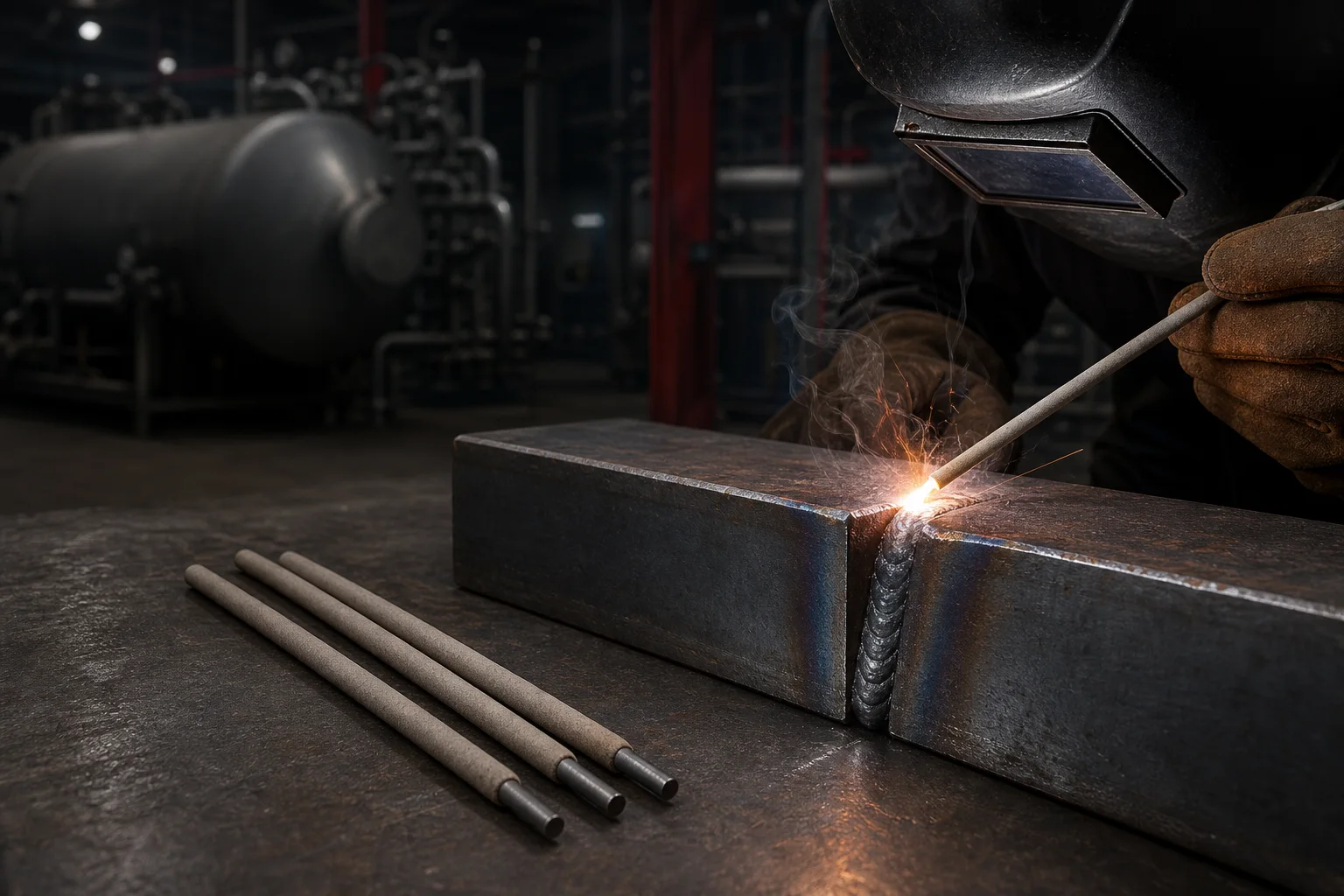
Selecting a low-alloy steel electrode is not a matter of comparing one strength number. E7018-A1, E8018-C3 and E9018 address different needs: elevated-temperature molybdenum-alloy service, documented low-temperature toughness, or a higher tensile-strength class. A poor choice may pass a tensile test yet remain unsuitable for impact toughness, chemistry, heat treatment or hydrogen-cracking control.
Why do low-alloy steels need a specific electrode?
Low-alloy steels use controlled additions of manganese, molybdenum, nickel, chromium or combinations of these elements to obtain strength, hardenability, creep performance or toughness. After dilution with the base metal and the actual welding thermal cycle, deposited weld metal must provide the required joint properties.
Excessively alloyed or over-strength weld metal can increase hardness and cracking sensitivity. Under-alloyed weld metal may fail to provide the required strength, toughness or temperature performance. A trade name or the first two classification digits are therefore insufficient.
What does the classification communicate?
In common AWS classifications, E identifies an electrode. The first two digits indicate the deposited-metal tensile-strength class: 70, 80 and 90 represent progressively higher nominal classes. Remaining digits and suffixes communicate welding position, coating/current characteristics and alloy family.
The code does not contain every project condition. Impact toughness at a specified temperature, as-welded versus PWHT performance, diffusible-hydrogen designation and chemistry restrictions must be checked in the current standard, certificate and manufacturer data.
Practical comparison: E7018-A1, E8018-C3 and E9018
| Classification | Selection focus | Potential use | Selection risk |
|---|---|---|---|
| E7018-A1 | Molybdenum-alloy weld metal and elevated-temperature performance | Qualified carbon-moly piping, process equipment and power/petrochemical repair | Substitution for ordinary E7018 without chemistry and PWHT review |
| E8018-C3 | Low-temperature toughness in a nickel-alloy family | Structures, vessels or equipment with specified low-temperature impact testing | Assuming nickel alone guarantees impact results |
| E9018 | Higher tensile-strength class | High-strength steels and joints whose WPS specifies this weld-metal class | Unnecessary overmatching, higher hardness and greater cracking sensitivity |
E7018-A1: where molybdenum matters
The A1 suffix commonly identifies a carbon-molybdenum weld-metal family. Molybdenum can help retain strength at elevated temperature, making the classification relevant to some process equipment, steam lines and power components. A1 alone, however, does not establish suitability for every heat-resistant steel.
Exact base grade, design temperature, service duration, thickness and postweld heat treatment must be reviewed. PWHT can change weld-metal strength and toughness, so as-welded certificate values cannot automatically qualify a PWHT joint.
See the E7018-A1 electrode product page for the available classification.
E8018-C3: select by toughness, not strength alone
The C3 family is commonly associated with nickel alloying to support low-temperature toughness. It can be relevant to vessels, outdoor equipment or structures subject to Charpy impact requirements. The project must still state the exact test temperature and minimum absorbed energy.
Toughness is the combined result of weld chemistry, heat input, interpass temperature, bead size, dilution, specimen direction and heat treatment. A broad statement such as “suitable for cold weather” is not a technical approval. Batch certification and the PQR should reflect the relevant temperature and condition.
See the E8018-C3 electrode page for product details.
E9018: higher strength is not always an advantage
E9018 belongs to a higher tensile-strength class than E7018 and E8018. Some high-strength steels require that capability, but using it on an ordinary joint can create unnecessary overmatching—weld metal substantially stronger than the base material.
Overmatching may transfer deformation into the heat-affected zone or base metal and can complicate cracking control in restrained joints. Higher-strength consumables also demand disciplined preheat, interpass-temperature, moisture and heat-input control. Follow the WPS and complete product classification rather than assuming that 90 is always better than 70.
Review the available E9018 electrode before submitting an enquiry.
Seven inputs for a defensible decision
1. Actual base-metal grade
“Alloy steel” is not sufficient. Record the standard, grade and delivery condition; for repair, include service history. Dissimilar joints require data for both sides and consideration of dilution.
2. Required mechanical properties
Review yield strength, tensile strength, elongation and impact toughness separately. Meeting tensile strength does not prove toughness.
3. Service temperature
Elevated-temperature service may require resistance to softening or creep, while low-temperature service focuses on fracture toughness. They are different metallurgical problems.
4. PWHT or as-welded condition
PWHT temperature and holding time can change precipitates, hardness and tensile properties. The consumable and PQR must be evaluated in the applicable condition.
5. Thickness and restraint
Greater thickness and restraint can increase residual stress and cracking risk. Preheat and welding sequence must come from the qualified procedure.
6. Hydrogen requirements
Hydrogen designators, packaging, atmospheric exposure and oven control must suit the project. See the E7018 storage and redrying guide for the complete handling chain.
7. Position, polarity and equipment
Electrode diameter, position, AC/DCEP capability and current range must match the datasheet and site access. Metallurgical suitability is not enough if the procedure cannot be executed consistently.
Preheat, interpass temperature and heat input
Preheat slows cooling and supports hydrogen diffusion, but its value must come from the project method or calculation. Excessive preheat combined with high heat input can also produce unsuitable microstructure or toughness.
Interpass temperature must remain within the WPS range. One initial reading is insufficient for a multipass joint; measurement location and timing should be defined. Current, voltage and travel speed are recorded to control heat input.
Common procurement and use errors
- Selecting only by the strength digits and ignoring the alloy suffix
- Replacing E7018-A1 with ordinary E7018 without engineering approval
- Ordering E9018 “for extra safety” when the WPS requires a lower class
- Approving E8018-C3 without checking impact temperature and energy
- Using certification from a different batch or diameter
- Ignoring PWHT effects on deposited-metal properties
- Failing to control low-hydrogen electrodes after opening
Technical enquiry checklist
- Complete standard and grade of each base metal
- Thickness, joint design and welding position
- Required yield and tensile strength
- Impact-test temperature and minimum energy
- Design temperature and service type
- As-welded condition or complete PWHT cycle
- Maximum hardness or NACE requirements, where applicable
- Hydrogen class, packaging and handling method
- Diameter, current, polarity and quantity
- Batch certification, manufacturer approval and PQR evidence
Conclusion
E7018-A1, E8018-C3 and E9018 are different answers to different engineering problems. A1 may address molybdenum-alloy and elevated-temperature needs; C3 becomes relevant where documented low-temperature toughness is required; E9018 applies when a genuinely higher strength class is defined by design and WPS. Final approval comes from matching product certification to base metal, service condition and the qualified PQR.
This article is an initial selection guide, not a replacement for the current standard, materials-engineering review, manufacturer data or an approved WPS/PQR. Every classification substitution must be approved in writing before use.