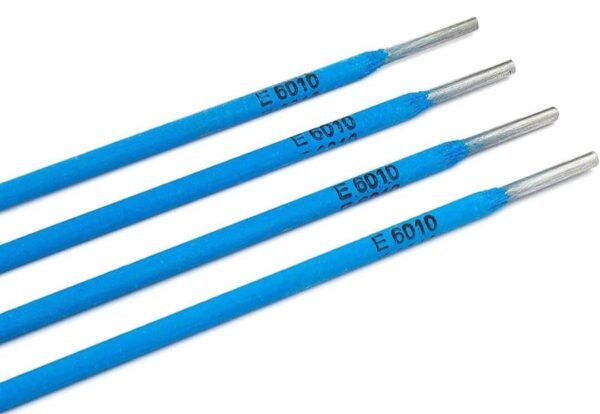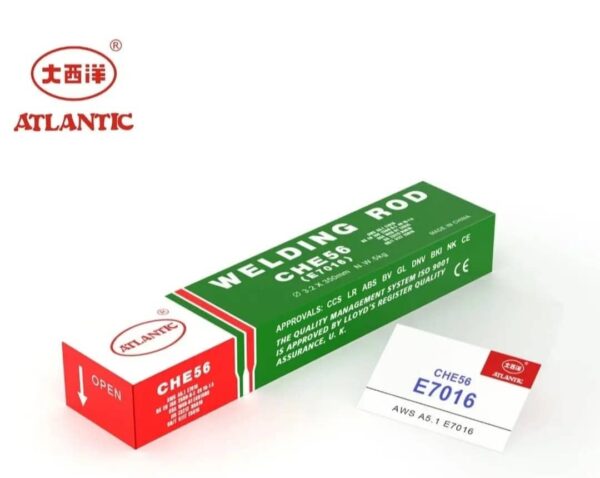
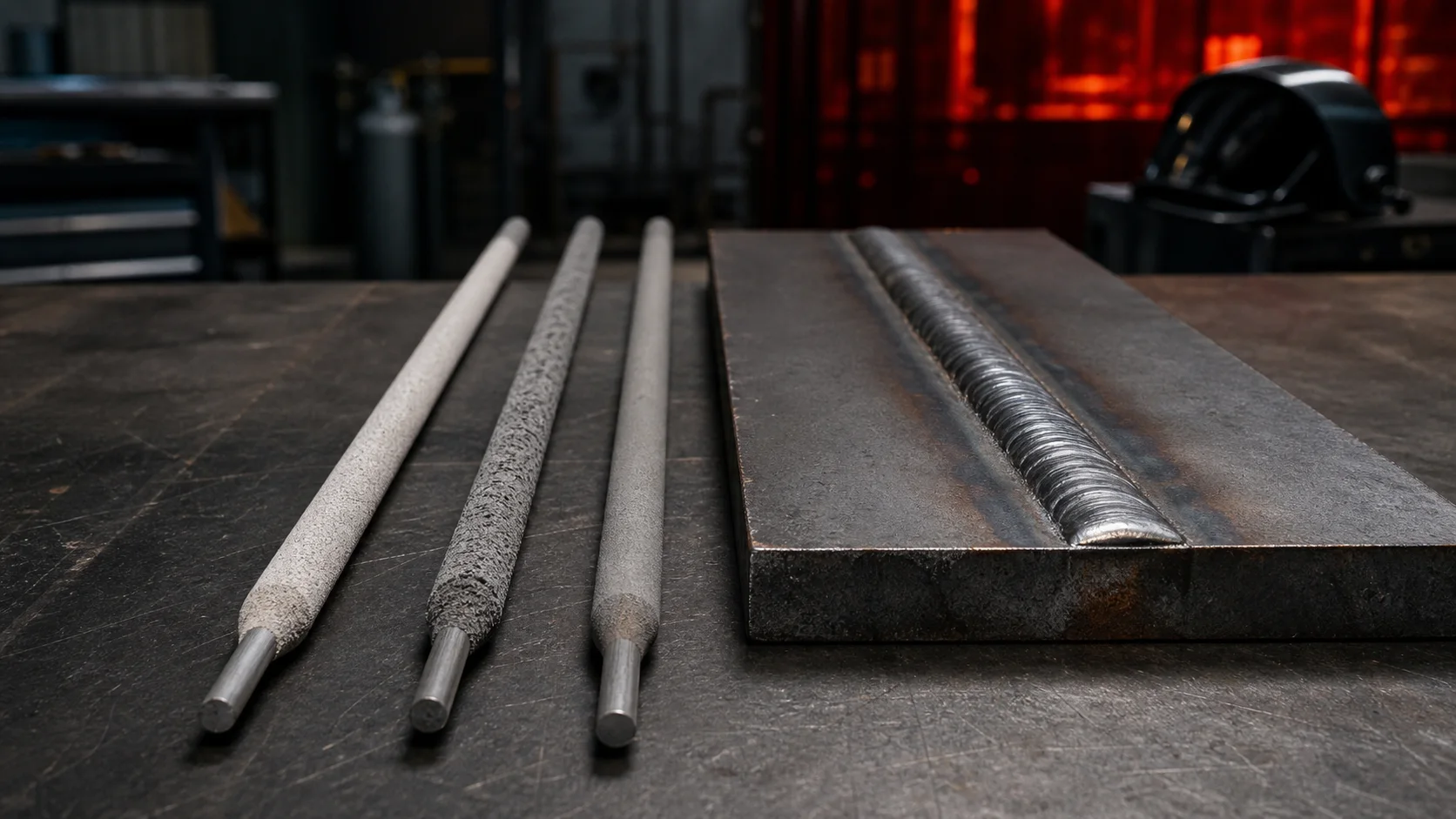
E6010, E7016 and E7018 are not interchangeable choices distinguished only by tensile strength. Their coating systems, penetration, slag behaviour, power-source requirements, diffusible-hydrogen characteristics and storage rules differ. Final selection must follow the drawing, project specification and an approved WPS.
What does the AWS classification tell us?
For carbon-steel covered electrodes, E identifies an electrode. The first two digits indicate minimum weld-metal tensile strength in thousands of psi. The next digit relates to welding position, while the final digits identify coating and usable current characteristics. The classification is a starting point; manufacturer data remains essential.
| Characteristic | E6010 | E7016 | E7018 |
|---|---|---|---|
| Coating family | High-cellulose sodium | Low-hydrogen potassium | Low hydrogen, commonly iron-powder bearing |
| Typical current | DCEP | AC or DCEP, subject to datasheet | AC or DCEP, subject to datasheet |
| Penetration | Deep and concentrated | Moderate and controlled | Moderate with good filling behaviour |
| Puddle behaviour | Fast freezing | Controlled | Generally more fluid than E6010 |
| Common context | Pipeline roots and positional work | Low-hydrogen fabrication and repair | Structures, vessels, equipment and fill passes |
E6010: deep penetration and a fast-freezing puddle
The cellulosic coating generates substantial shielding gas and supports a forceful, penetrating arc. Its fast-freezing puddle is useful for open-root work and positional pipeline welding. E6010 is normally operated on DCEP and is not a suitable assumption for an AC-only power source.
Cellulosic electrodes must not be treated like low-hydrogen electrodes. Moisture in the coating system contributes to their designed operation, so low-hydrogen baking instructions must never be applied to E6010. Follow the manufacturer’s storage instructions.
E7016: low hydrogen with controlled puddle behaviour
E7016 belongs to the low-hydrogen family. Its smooth arc and manageable slag can suit joints where hydrogen-assisted cracking must be controlled. Compared with E7018, its coating generally contains less iron powder, so deposition behaviour and bead profile are not identical.
AC or DCEP capability depends on the complete product classification and manufacturer. The grade alone does not define amperage, storage temperature or exposure limits; diameter-specific data must be reviewed.
E7018: low hydrogen with productive filling
E7018 is one of the most widely used structural electrodes. Its low-hydrogen, iron-powder coating commonly provides a calm arc, uniform bead and useful deposition rate. For higher-strength steels, thick components or highly restrained joints, hydrogen control must be combined with the WPS requirements for preheat and interpass temperature.
Low-hydrogen performance is preserved only when packaging, storage, atmospheric exposure and heated field containers are controlled. A damp electrode may still strike an arc while increasing the risk of porosity or delayed cracking.
Which family fits each scenario?
Pipeline root pass
Where the qualified WPS specifies a cellulosic root on DCEP, E6010 may be the intended choice. Joint geometry, root opening, welder qualification and governing code remain part of the decision. See the pipe-welding electrode guide to separate the root decision from hot, fill and cap passes.
Structural and restrained joints
E7016 or E7018 may be more appropriate where hydrogen control is important. Deposition rate, welding position, impact requirements and WPS approval determine the final selection.
Repair welding
Base-metal identity and service history must be established. Selecting whatever electrode is available can create a mismatch in strength, hardness or toughness.
Can E7018 replace E6010?
Not automatically. Higher nominal strength does not compensate for different penetration, puddle control, technique and hydrogen behaviour. An electrode change may be an essential WPS variable and require engineering review or requalification. The same caution applies when switching between E7016 and E7018.
Information to confirm before ordering
- Base-metal grade and thickness
- Joint type and welding position
- Available power source and required polarity
- Impact toughness and test temperature
- Preheat, interpass and heat-treatment requirements
- Diameter, quantity and package format
- Site storage and moisture-control arrangements
This guide supports initial selection. Amperage, holding temperature, exposure time and redrying parameters must come from the specific manufacturer datasheet and approved WPS.