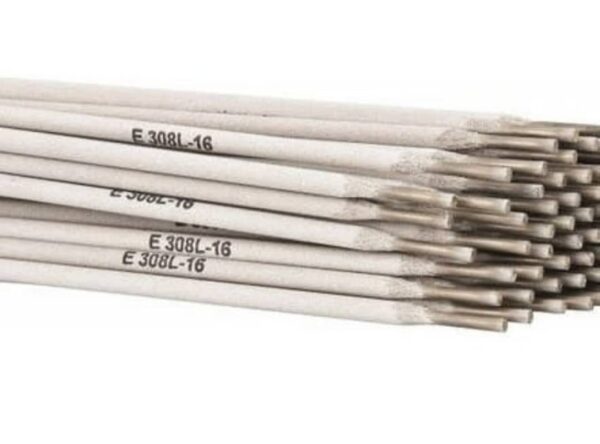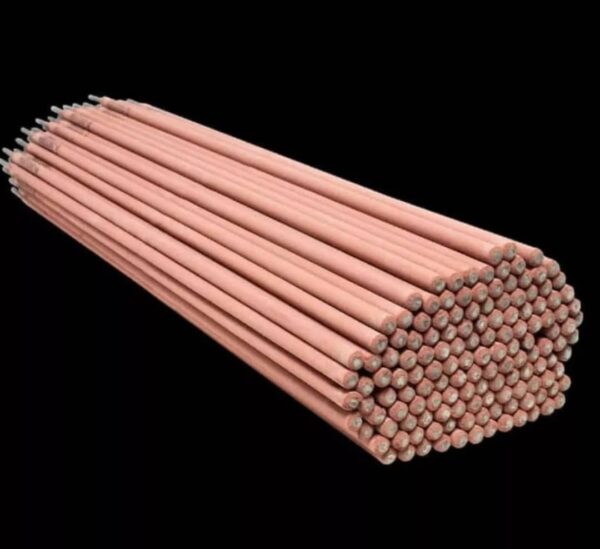
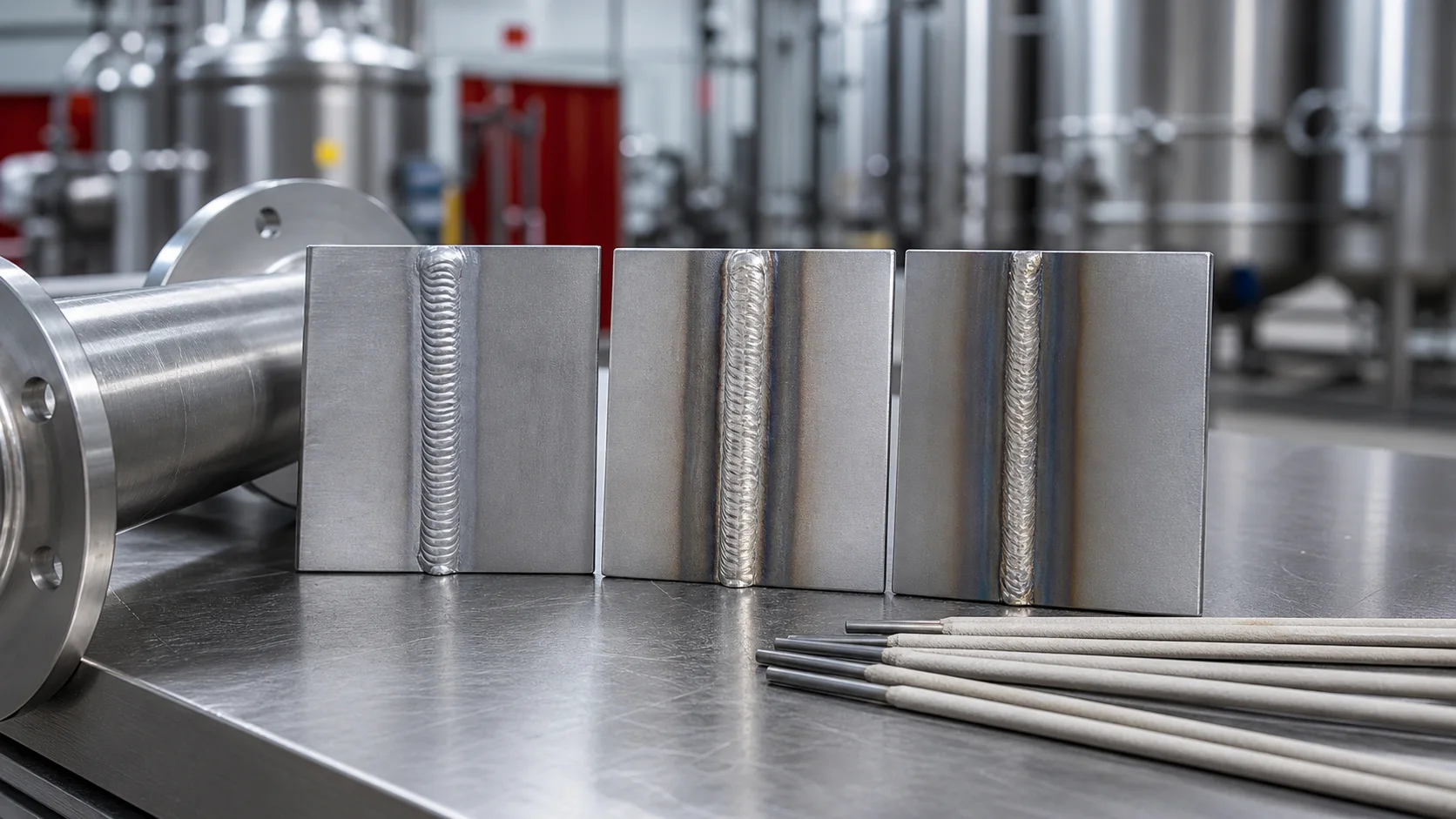
Selection among E308L-16, E309L-16 and E316L-16 should begin with base metal, joint type and service environment. The generic description “stainless electrode” is not enough: alloy differences influence corrosion resistance, dilution and hot-cracking behaviour.
What do L and the -16 suffix mean?
L indicates lower weld-metal carbon. Reduced carbon helps limit chromium-carbide precipitation and sensitisation risk, particularly where the joint will face corrosive service. It does not guarantee corrosion resistance in every environment.
The -16 suffix relates to coating and operating characteristics. Many products can operate on AC and DCEP, but polarity, amperage and approved positions must come from the product datasheet.
| Classification | Common application | Selection point |
|---|---|---|
| E308L-16 | 304 and 304L stainless | Common matching choice for this austenitic family |
| E309L-16 | Stainless to carbon steel, overlays and selected dissimilar joints | Higher alloy content helps accommodate dilution |
| E316L-16 | 316 and 316L stainless | Molybdenum supports improved performance in some corrosive media |
E308L-16: the common 304/304L choice
This family is widely used in food equipment, tanks, piping and stainless structures made from 304 or 304L. If either component is 316, duplex, carbon steel or unidentified material, automatic selection of E308L is inappropriate.
High-temperature service, chloride exposure and heat-treatment conditions require separate metallurgical review. Weld-metal corrosion behaviour must suit both base metal and service environment.
E309L-16: dissimilar joints and overlays
E309L contains more chromium and nickel than 308L and is commonly used for joining stainless to carbon steel or for the first layer of a stainless overlay. As carbon steel melts into the pool, weld composition is diluted; the higher alloy level helps preserve a more suitable structure.
This does not make E309L correct for every dissimilar joint. Thermal expansion, service temperature, thermal cycling and carbon migration may all require engineering consideration.
E316L-16: molybdenum for more demanding corrosion conditions
E316L is a common choice for 316 and 316L where improved pitting resistance over the 304 family is required. Molybdenum improves behaviour in some chloride environments, but 316L is not immune to every concentration, temperature or chemical.
Process fluid, concentration, temperature, velocity, cleaning cycles and post-weld surface condition all matter. A higher alloy, different process or additional surface treatment may be needed.
Why dilution matters
Deposited weld metal is not pure electrode metal; both joint faces contribute to the pool. Excessive dilution can reduce chromium and nickel, change microstructure or increase cracking susceptibility. Current, electrode angle, travel speed, joint design and pass sequence affect dilution.
Control of iron contamination
Brushes, grinders, benches and tools previously used on carbon steel can transfer iron particles to stainless surfaces. Those particles later rust and damage appearance or surface performance. Dedicated stainless tools, segregated storage and correct cleaning are essential.
Heat tint and post-weld cleaning
Coloured oxide around the weld indicates that the passive surface layer has been affected by heat. Controlled mechanical cleaning, pickling or passivation may be required depending on service. The method must comply with safety rules, material requirements and project specifications.
Common selection mistakes
- Using E308L for stainless-to-carbon-steel joints without checking dilution
- Assuming E316L resists every chloride environment
- Selecting by electrode appearance rather than classification and certification
- Ignoring exact base grade or previous consumables during repair
- Using carbon-steel-contaminated tools on stainless surfaces
Information to confirm before ordering
- Exact grade of both components
- Matching or dissimilar joint
- Process fluid and corrosion conditions
- Design temperature and thermal cycle
- Thickness, joint design and welding position
- PWHT, cleaning or passivation requirements
- Diameter, polarity, quantity and required standard
Corrosive and high-temperature service requires materials-engineering and WPS approval. A trade name or alloy number alone cannot guarantee performance.