In submerged arc welding, wire and flux are not independent commodities selected in isolation. Weld-metal properties, bead shape, penetration, slag release and cracking response depend on the wire–flux combination. Replacing EM12 with EM12K—or changing flux brand—without reviewing combination certification and the WPS can change mechanical-test results.
How does submerged arc welding work?
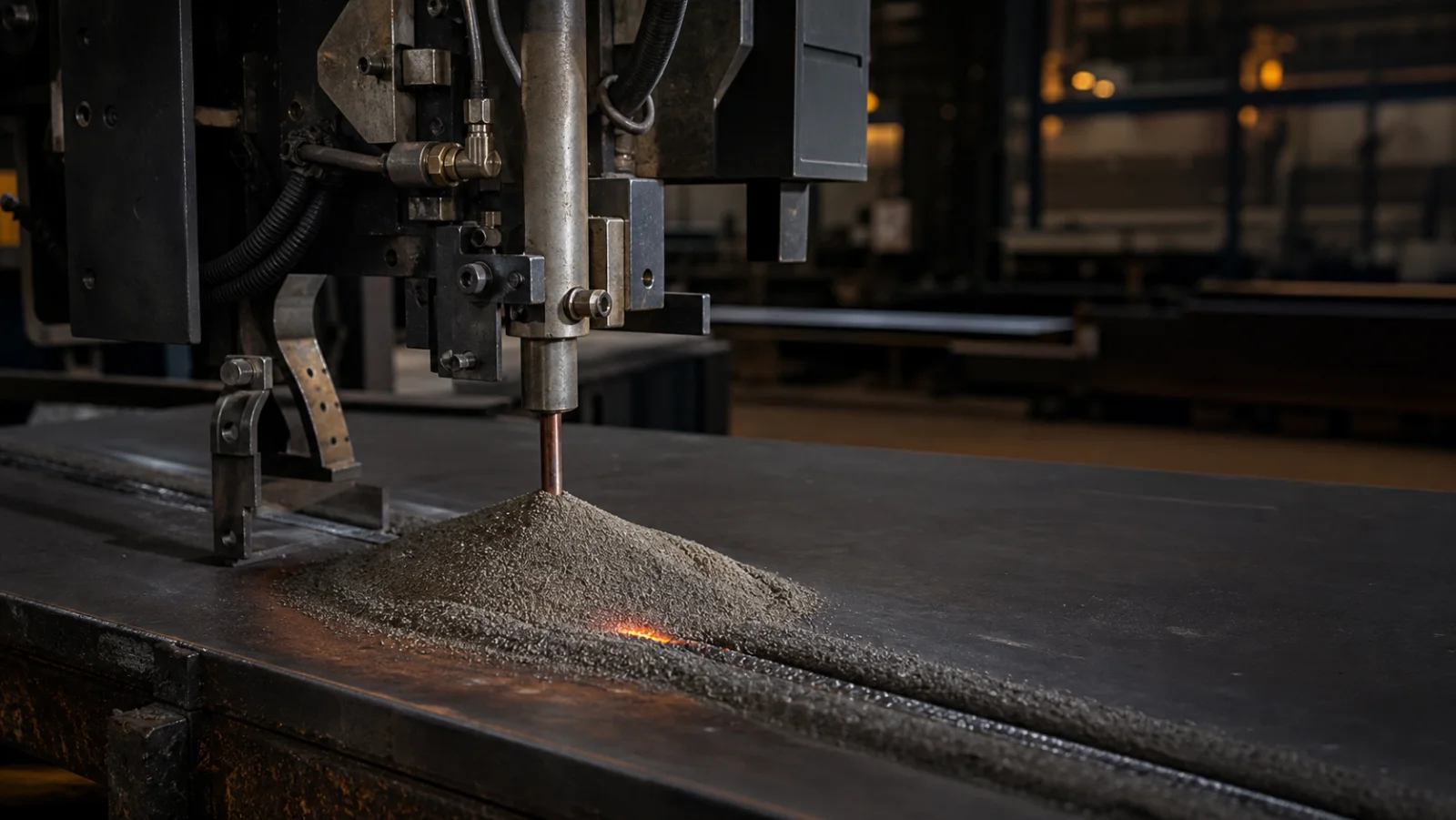
SAW continuously feeds one or more wires into the joint while the arc operates beneath a bed of granular flux. The flux shields the molten pool and forms a slag layer as the weld solidifies. High deposition rate, controllable penetration and straightforward mechanisation make SAW useful for vessels, built-up beams, pipe, heavy structures and overlay work.
A hidden arc does not make the process simple. Contact-tip-to-work distance, head alignment, flux depth, wire-feed speed, voltage, current and travel speed must remain stable. Each variable can alter bead geometry and base-metal dilution.
What is the difference between EM12 and EM12K?
EM12 and EM12K are familiar carbon-steel wires for SAW. Both are used in general fabrication, but their chemistry is not identical. EM12K generally contains more manganese and silicon than EM12 and therefore provides greater deoxidising capacity. That difference may be useful with limited surface oxide or particular flux systems.
| Topic | EM12 | EM12K |
|---|---|---|
| Product form | Solid SAW wire | Solid SAW wire |
| General chemistry | More moderate Mn and Si | Usually higher Mn and Si |
| Deoxidation | Depends strongly on flux and surface condition | Better tolerance of limited oxide, not heavy contamination |
| Final selection | Based on wire–flux certification and WPS/PQR testing | |
The K suffix is not permission to weld over oil, moisture or heavy rust. Loose mill scale, paint and joint contamination must be removed as required by the procedure. The same EM12K wire paired with two different fluxes may produce different weld-metal properties.
Flux does more than shield the arc
SAW flux affects arc stability, bead shape, slag release, alloy transfer, diffusible hydrogen and mechanical properties. Agglomerated and fused fluxes differ in manufacture and moisture behaviour. Neutral and active classifications describe how strongly a flux can influence weld-metal chemistry.
Neutral flux
Neutral flux is designed to limit changes in weld-metal chemistry and is commonly considered for multipass welds where element build-up matters. Neutral does not mean completely inert or compatible with every wire.
Active flux
Active flux can add elements such as manganese or silicon and may improve bead appearance or tolerance to limited surface oxide. As voltage and flux consumption increase, element transfer can change, so operation outside the qualified parameter range may alter properties.
Basicity and toughness
Basicity index is sometimes used to compare flux metallurgical behaviour. Basic fluxes in suitable combinations may reduce weld-metal oxygen and support toughness, but the number alone cannot guarantee a result. Wire chemistry, heat input, pass sequence and dilution act together.
Why combination classification matters
Under AWS specifications for SAW consumables, deposited-weld properties are generally evaluated for a specific electrode-and-flux combination. The complete classification can communicate strength, heat-treatment condition and impact-toughness capability. Flux certification should therefore identify the wire used for classification and the applicable test condition.
Where a project requires low-temperature toughness, PWHT, hydrogen limits or restricted chemistry, ordering EM12 or EM12K by name is insufficient. Material certificates, manufacturer data and PQR results must match actual fabrication conditions.
Polarity and welding parameters
- Current: primarily influences wire melting rate and penetration. Excessive current may create unsuitable geometry, edge wash or greater thermal stress.
- Voltage: affects arc length, bead width and flux melting. With an active flux, voltage changes may also affect deposited chemistry.
- Travel speed: changes heat input and bead cross-section and can contribute to undercut or inadequate penetration when poorly controlled.
- Polarity: DCEP, DCEN and AC change the balance among penetration, deposition and magnetic arc blow. Selection must follow the WPS and consumable recommendation.
- Contact-tip distance: stick-out changes resistive wire heating and melting rate; variation creates process instability.
Moisture control and flux recovery
Flux should remain in intact packaging in a dry location away from damp floors. Holding or redrying temperatures are product-specific and must come from the manufacturer. Incorrect heating can alter particle distribution or operating behaviour.
Recovered flux must be separated from slag, metal particles and excessive fines and then screened. The permitted ratio of new to recovered flux, number of cycles and storage method should be defined by procedure. Returning damp or contaminated recovery to the main hopper places the full batch at risk.
Common defects and first checks
| Indication | Items to investigate |
|---|---|
| Porosity | Flux moisture, surface contamination, insufficient flux depth and unstable feeding |
| Difficult slag release | Wire–flux combination, pass profile, voltage, interpass temperature and overlap |
| Undercut | Excessive voltage or speed, head position and poor metal distribution |
| Incomplete penetration | Current, polarity, travel speed, joint design and wire placement |
| Cracking | Hydrogen, weld chemistry, restraint, preheat, heat input and sequence |
Information for an accurate SAW enquiry
- Base-metal grade, thickness and surface condition
- Design standard and required complete classification
- Tensile and impact properties at the test temperature
- As-welded or post-weld heat-treated condition
- Wire classification, diameter and package format
- Approved flux classification paired with that wire
- Single-wire, multiwire, tandem or strip-cladding arrangement
- Current, polarity, voltage, speed and heat-input range
- Batch certification, hydrogen and project-approval requirements
Review the related EM12 submerged-arc wire, EM12K submerged-arc wire and submerged-arc welding flux. The final combination must be checked against the project WPS and technical certification.
This article supports initial technical selection and does not replace the current standard, manufacturer data or an approved WPS/PQR. Any change in wire, flux, polarity or parameter range must be reviewed against the project’s essential variables.